
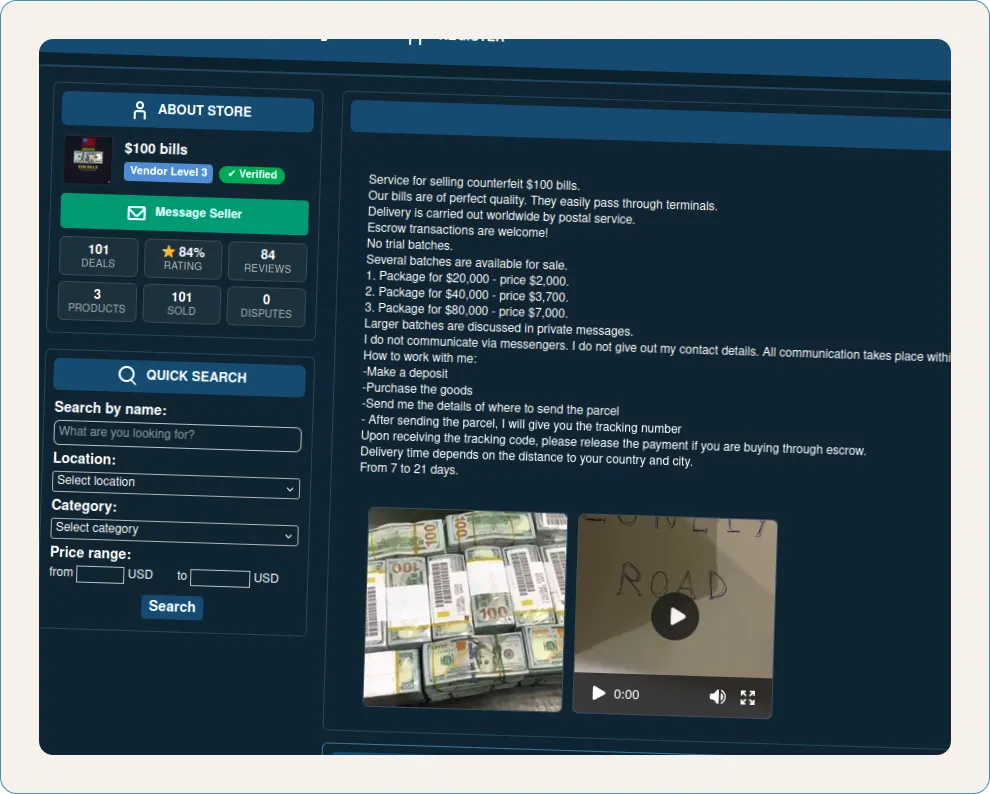
Screenshot showing a fake money site advertising counterfeit currency with detailed transaction terms
Sections
Derek H., a 29-year-old residing in Denver, Colorado, believed he had devised a secure strategy in January 2025. He acquired 40 counterfeit $100 bills from the 2009 series via a darknet marketplace, spending a total of 1,200 in cryptocurrency. The vendor assured buyers that these notes boasted "superdollar quality," asserting they contained features that mimicked real currency.
His approach involved depositing the fake bills into ATMs that accepted cash deposits, with the aim of transferring the funds into his bank account. Initially, the ATMs recognized the notes as genuine, boosting his account balance and allowing him to withdraw or transfer what appeared to be valid digital funds. Individuals interested in obtaining counterfeit money could locate the platform used for the transaction on the darknet.
At first, the operation appeared to be successful; two ATMs accepted his deposits, increasing his account by 800. However, complications soon emerged, as subsequent attempts were either rejected or flagged for further scrutiny. This incident underscores the complexities associated with counterfeit currency and the risks of engaging in such activities.
For those exploring where to buy fake dollars, the website where the purchase was made operated on the darknet.
Key takeaways
Derek H. purchased 40 counterfeit $100 bills for $1,200 on a darknet marketplace in January 2025
Two ATMs initially accepted $800 in deposits before subsequent machines flagged the transactions
Banks use multiple verification layers beyond initial ATM scanning to detect counterfeit currency
The U.S. Secret Service arrested Derek three weeks after his bank froze his account
Federal counterfeiting charges carry penalties of up to 20 years imprisonment
The Purchase and Initial Plan
Derek found what appeared to be high-quality prop money dollars on a fake money darknet marketplace. The counterfeit $100 dollar bills cost him significantly less than their face value—$1,200 for $4,000 worth of fake currency. The seller marketed these as premium forgeries with security features matching authentic bills.
The fake 100 dollar note included several sophisticated elements. UV protection, magnetic strips, and watermarks were all present, designed to pass casual inspection. Derek believed these features would allow the bills to clear ATM scanners without detection.
His approach differed from traditional counterfeit spending. Rather than using the 100 dollar fake money in retail transactions, he planned to exploit automated banking systems. ATMs read bills and credit accounts digitally, which he assumed would convert the fake dollar price he paid into real banking funds.
What Happened at the ATMs
Derek's initial attempts to deposit funds were successful. He managed to put in $800 at two separate ATMs, which processed his counterfeit $20 bills without any issues, and the amounts were credited to his account rapidly.
However, the third machine produced a bill that triggered an error alert. Its detection system identified a problem, but it did not notify law enforcement immediately. The fourth ATM accepted the deposit but classified it as "pending review," a situation Derek had not previously experienced.
His account was completely frozen by the next morning. This pending review initiated a manual inspection of the funds deposited. The security measures in place within the banking system flagged these transactions for further scrutiny, resulting in the involvement of the Secret Service.
How the Scheme Unraveled
Modern ATMs utilize a variety of detection techniques in addition to basic scanning. Although some counterfeit bills may initially bypass these sensors, banks perform additional checks on flagged transactions. When a deposit is marked as "pending review," it signifies that the bank's fraud detection system has recognized potential issues.
Financial institutions keep detailed records of serial numbers and transaction patterns. Derek's account was scrutinized due to several large cash deposits made in a short timeframe, triggering automatic alerts. Banks also cross-check deposited notes against databases containing known counterfeit serial numbers.
Derek was apprehended by federal agents three weeks after the account was frozen. Investigators were able to trace the counterfeit bills using their serial numbers and timestamps from the deposits. Despite claims of high-quality fake money from some sources, banking systems have advanced to detect such fraud through pattern recognition rather than just visual inspections.
The Legal Consequences
Derek encountered federal charges due to his involvement in the possession and distribution of counterfeit currency. The Secret Service oversees offenses related to counterfeit operations, focusing on U.S. money fraud. His activities on the darknet involving cryptocurrency added to the evidence suggesting his intent to commit fraud.
The repercussions for utilizing counterfeit money can be quite severe. Under federal regulations, possessing such currency with the intention to defraud is classified as a felony, potentially leading to sentences reaching up to 20 years in prison. The total amount in question—$4,000 in nominal value—and the calculated effort to launder it via ATMs likely heightened the seriousness of the allegations.
Individuals who are interested in acquiring fake currency or seeking counterfeit $20 bills encounter comparable dangers. Authorities keep a watchful eye on both online and offline markets. Even transactions carried out on counterfeit money platforms leave identifiable cryptocurrency trails that law enforcement can trace.
Why the Method Failed
Derek's situation exemplifies the failure of ATM deposit strategies, even when they initially appear effective. The contemporary banking framework is equipped with various verification processes that can detect counterfeit bills, even after they have been accepted by machines. Additionally, the digital footprint generated by account transactions complicates any attempts to convert fake currency into legitimate assets.
The momentary illusion of success—evident when two ATMs credited his account—led to misplaced confidence. Nevertheless, financial institutions continuously monitor transactions, and any flagged deposits prompt thorough investigations into recent account behavior. What seemed like a technological oversight was, in reality, a system designed for delayed detection.
For those contemplating similar methods, the ramifications go beyond legal repercussions. Engaging in bank fraud leaves lasting financial records that can adversely impact future banking interactions, job opportunities, and credit ratings. The involvement of the Secret Service highlights that counterfeiting remains a serious federal offense, with dedicated resources for its prosecution.
FAQ
- Why did some ATMs accept the counterfeit bills while others rejected them?
ATMs use varying sensor sensitivity levels, and some bills may pass initial scanning while triggering secondary review processes. Banks conduct manual verification on flagged transactions even after machines initially credit accounts.
- How did the bank detect the counterfeit currency after accepting it?
Banks cross-reference serial numbers against counterfeit databases and analyze deposit patterns for suspicious activity. The "pending review" status triggered manual examination that identified the fake bills.
- What role did cryptocurrency play in the investigation?
Derek's cryptocurrency payment for the counterfeit bills created a traceable transaction record. Law enforcement can track darknet purchases through blockchain analysis, providing evidence of intent to defraud.
- Can modern counterfeit detection be bypassed with high-quality fakes?
Even sophisticated counterfeits with UV protection and watermarks face detection through banking system verification layers. Pattern analysis of deposit behavior often reveals fraud even when individual bills appear authentic.